Top 10 Porto Azulejo Tile Photography Spots 2026
Explore the best Porto azulejo tile photography spots for 2026, from ornate train stations to quiet chapels.
Introduction: Why Porto Azulejo Tile Photography Spots Are a Dream for Visual Storytellers
If you are searching for the very best Porto azulejo tile photography spots in 2026, you have landed in the right place. Porto is a city where every corner feels like a curated museum of blue-and-white ceramic storytelling. The azulejo tradition here is not just decorative — it is a living archive of Portuguese history, faith, and artistry. As a photographer, you will find yourself drawn to the way light plays across these hand-painted tiles, shifting from cool morning blues to warm golden-hour glows. In this guide, I will walk you through ten incredible locations where you can capture the magic of Porto's azulejos, with detailed tips on lighting, angles, composition, framing, and the overall vibe of each spot. Whether you are a seasoned travel photographer or a passionate hobbyist, these Porto azulejo tile photography spots will transform your portfolio and deepen your appreciation for this iconic art form.
Porto's azulejos date back to the 15th century, influenced by Moorish ceramic traditions. The tiles were originally used in monochrome blues, but over time, they evolved into intricate narrative panels depicting religious scenes, historical events, and everyday life. Today, they adorn churches, train stations, university buildings, and even private homes. The key to photographing them well is understanding how light interacts with the glazed surfaces — direct sunlight can cause harsh reflections, while overcast skies produce an even, soft illumination that brings out the deep cobalt tones. Let's dive into the top ten locations, starting with a true icon.
1. Sao Bento Train Station: The Crown Jewel of Porto Azulejo Tile Photography Spots
A Brief History of the Panels
Completed in 1916, Sao Bento Train Station is arguably the most famous of all Porto azulejo tile photography spots. The station's atrium is covered with over 20,000 azulejo tiles, depicting scenes from Portugal's history, including the Battle of Valdevez and the Conquest of Ceuta. The artist Jorge Colaco spent 11 years creating these masterpieces. The sheer scale of the panels will leave you speechless — they cover the entire lower half of the main hall, wrapping around the walls like a giant storybook.
Photography Tips for Sao Bento
Best time to shoot: Early morning (around 7:00–8:30 AM) before the crowds arrive. The station opens at 6:00 AM, so you can have the hall almost to yourself. Lighting: The overhead skylights provide soft, diffused natural light. Avoid using flash as it will wash out the subtle gradations of blue. Angles and composition: Use a wide-angle lens (16–24mm) to capture the full sweep of the panels. For detail shots, switch to a 50mm or 85mm prime and focus on specific narrative elements — a knight on horseback, a sailing ship, or a royal figure. Framing: Look for frames within frames: the arched doorways and ticket windows create natural borders for your shots. Vibe: Elegant, historic, and surprisingly serene for a working train station. The clatter of trains and the murmur of travelers add a layer of sonic texture, but visually, it is pure tranquility.
Pro Photography Tip: Use a polarizing filter to cut through the subtle glare on the glazed tiles. This will deepen the blues and reveal the intricate brushwork that is often lost in reflections. Set your aperture to f/8 or f/11 for maximum sharpness across the entire panel.
Walking Directions
Sao Bento is located on Praca Almeida Garrett, right in the city center. If you are staying in the Ribeira district, it is a 10-minute walk uphill. Look for the grand facade with the historic clock tower. The main entrance leads directly into the azulejo hall.
2. Capela das Almas: A Hidden Gem in the Heart of the City
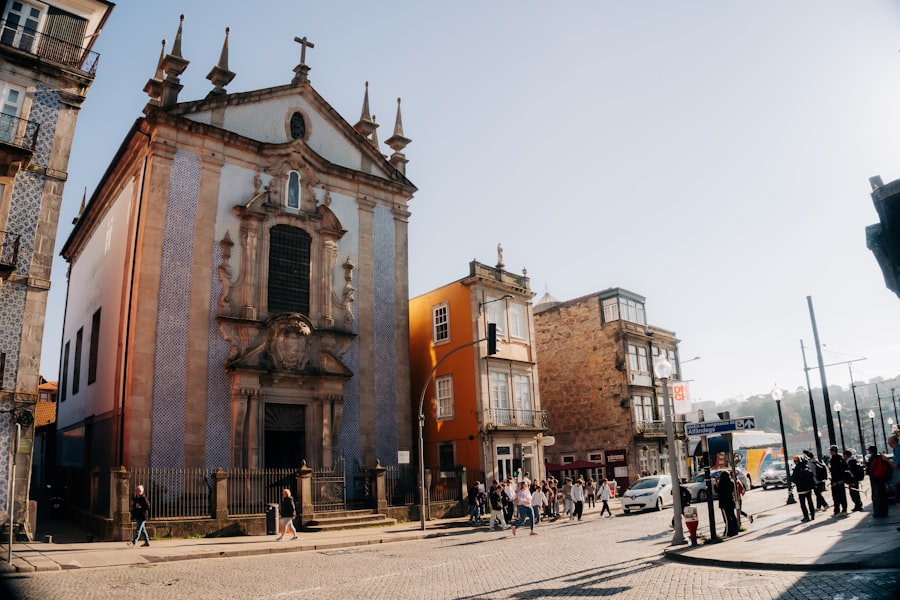
Located on Rua de Santa Catarina, the Capela das Almas (Chapel of Souls) is a smaller but equally stunning Porto azulejo tile photography spot. The chapel's exterior is completely covered in blue-and-white tiles depicting scenes from the lives of Saint Francis and Saint Catherine. Unlike the grand interior of Sao Bento, this chapel offers an outdoor, street-level experience. The tiles are arranged in geometric patterns and figurative panels, all under the open sky.
Best time to shoot: Late afternoon (3:00–5:00 PM) when the sun hits the facade at a 45-degree angle, creating beautiful shadows and highlights. Lighting: Direct sunlight can be harsh, so use a lens hood to avoid flare. On cloudy days, the light is perfectly even. Angles and composition: Stand directly across the narrow street to capture the full facade. Use a telephoto lens (70–200mm) to isolate details like the crowns, halos, and floral motifs. Framing: Include the street level with its shop awnings and cafe tables to add a sense of scale and everyday life. Vibe: Intimate, spiritual, and slightly bustling with shoppers. The contrast between the sacred tiles and the modern storefronts makes for compelling storytelling.
3. Igreja do Carmo: Baroque Beauty and Giant Azulejo Panels
The Carmo Influence on Porto's Tile Tradition
The Igreja do Carmo, built in the late 18th century, features a massive lateral azulejo panel that runs the entire length of the church. This panel, added in 1912, depicts scenes from the founding of the Carmelite Order. It is one of the most photographed Porto azulejo tile photography spots because of its sheer size — over 15 meters long and 6 meters high. The church is located on Rua do Carmo, near the Clerigos Tower.
Camera Settings and Composition
Lens choice: A 24–70mm zoom is ideal here. For the full panel, step back into the small garden across the street. For close-ups, move in and focus on the details of the monks' robes and the architectural elements. Lighting: The panel faces west, so it is beautifully lit in the late afternoon. Angles: Shoot from a low angle to emphasize the height of the panel, and include the ornate church windows above for contextual framing. Vibe: Peaceful and contemplative, with the sound of bells from the nearby tower. The small garden has a bench where you can sit and compose your shots.
- Recommended gear: Tripod for long exposures in low light, polarizing filter, wide-angle and telephoto lenses.
- Best season: Spring and autumn for mild weather and soft light. Summer has harsh shadows, winter has dramatic overcast skies.
- Extra tip: Visit on a weekday to avoid the weekend crowds that gather for weddings at the church.
4. Palacio da Bolsa: Opulence and Tilework in the Stock Exchange
The Palacio da Bolsa (Stock Exchange Palace) is a neoclassical masterpiece that houses the famous Arab Room, but its azulejo tiles are equally magnificent. The entrance hall and several salons are covered in blue-and-white panels depicting Portugal's maritime history and industrial progress. This is a Porto azulejo tile photography spot that combines architecture, history, and artistry in one lavish package. The tiles here are more formal and symmetrical than at other locations, reflecting the building's mercantile purpose.
Photography conditions: Interior lighting is mixed — natural light from tall windows mixes with warm artificial light. Use a custom white balance set to around 4000K to avoid yellow casts. Angles: Shoot upward to capture the vaulted ceilings with their intricate tilework. Use a tripod for long exposures at f/8 to ensure sharpness. Vibe: Grand, formal, and slightly hushed. Guided tours are required, so plan your shoot around the tour schedule to get empty rooms.
5. Casa da Musica: Modern Azulejos with a Twist
Not all Porto azulejo tile photography spots are historic. Casa da Musica, designed by Rem Koolhaas, features a contemporary azulejo installation on its exterior. The tiles are arranged in a pixelated, abstract pattern that changes with the light. This is a fantastic spot for photographers who love modern geometry and color contrasts. The building is located on Avenida da Boavista, about a 20-minute walk from the city center.
Best time to shoot: Golden hour, when the low sun creates long shadows across the tiled facade. Lighting: The white tiles reflect light beautifully, so expose for the highlights to keep the blue tones from clipping. Angles and composition: Use leading lines — the building's sharp angles and the ramp leading to the entrance create dynamic compositions. Framing: Include the surrounding park and modern street furniture for a contemporary vibe. Vibe: Energetic, futuristic, and architecturally bold. The contrast between the old city and this modern structure is striking.
Pro Photography Tip: For abstract shots, use a telephoto lens to isolate small sections of the pixelated tile pattern. This will create a minimalist, almost digital aesthetic. Experiment with black and white conversion to emphasize the geometric shapes.
6. Igreja de Sao Francisco: Gothic Grandeur and Azulejo Accents
The Igreja de Sao Francisco (Church of Saint Francis) is a Gothic church with a stunning Baroque interior. While the church is famous for its gilded woodwork, it also features beautiful azulejo panels in the cloister and side chapels. This is a less crowded Porto azulejo tile photography spot, perfect for those who want to practice their low-light photography. The tiles here depict floral motifs and religious symbols in deep blues and yellows.
Camera settings: This is a low-light environment. Use a fast prime lens (50mm f/1.4) and crank up the ISO to 1600–3200. Noise is acceptable in this setting, as it adds to the moody vibe. Angles: Focus on the contrast between the gold leaf and the blue tiles — this creates a rich, opulent color palette. Vibe: Mystical, solemn, and deeply atmospheric. The silence inside is palpable.
Walking Directions from Sao Bento
From Sao Bento, walk downhill toward the Douro River. The church is on Rua do Infante D. Henrique, about 7 minutes on foot. Look for the plain Gothic facade — the interior is a complete surprise.
7. Jardins do Palacio de Cristal: Tiles in the Gardens
The Crystal Palace Gardens offer a unique combination of azulejo panels and natural beauty. Several benches and fountains in the gardens are decorated with hand-painted tiles. This is a wonderful Porto azulejo tile photography spot for those who want to incorporate greenery and water into their compositions. The gardens are perched on a hill overlooking the Douro River, so you get panoramic views as a bonus.
Best time to shoot: Mid-morning, when the light filters through the trees and dapples the tiles. Angles: Shoot from above to include the river in the background, or get low to the ground and use the tiles as a foreground element. Framing: Use the tree branches as natural frames. Vibe: Relaxed, romantic, and slightly whimsical. Families and couples wander through, adding a human element to your shots.
- Gear tip: Bring a reflector to bounce light onto the tiles in shaded areas.
- Safety note: The gardens have peacocks that roam freely — they make excellent subjects alongside the tiles.
- Seasonal note: In spring, the flowers around the fountains add pops of color to your azulejo compositions.
8. Rua das Flores: A Street-Lover's Paradise for Tile Photography
Rua das Flores (Street of Flowers) is a pedestrianized street in the historic center, lined with buildings that feature azulejo tiles on their facades. This is one of the most photogenic Porto azulejo tile photography spots because of the variety — you can find everything from 18th-century blue-and-white panels to 20th-century geometric designs. The street is narrow, creating a natural corridor that leads the eye.
Best time to shoot: Early morning, before the shops open and the street fills with tourists. Lighting: The tall buildings create a canyon effect — light hits the upper floors first, then slowly works its way down. Shoot in the late morning for even illumination. Angles: Look up! The upper floors often have the best-preserved tiles. Use a wide-angle lens and tilt slightly upward. Vibe: Charming, bohemian, and lively. Artists sell their work on the street, and the smell of fresh coffee wafts from the cafes.
9. Igreja de Santo Ildefonso: Symmetry and Ceremonial Blues
This 18th-century church on Praca da Batalha is covered in azulejo tiles on its facade, with a symmetrical design that is perfect for minimalist compositions. The tiles were added in 1932 by artist Jorge Colaco (the same artist behind Sao Bento). This is a must-visit Porto azulejo tile photography spot for those who love symmetry and clean lines.
Camera settings: Use a tripod and a 24mm lens to capture the full, perfectly symmetrical facade. Set your aperture to f/11 for maximum depth of field. Lighting: The facade faces east, so it is best in the morning. Angles: Stand directly in front, centered on the main door, for a classic, formal composition. Then move to the side for a more dynamic, off-center perspective. Vibe: Ceremonial, stately, and peaceful. The square in front has a fountain and benches where you can sit and admire the tiles.
10. Estacao de Sao Bento Viewpoint: The Ultimate Overview of Porto Azulejo Tile Photography Spots
Our final spot is not a location in itself, but a viewpoint that offers a unique perspective on the city's tile heritage. From the top of the Clerigos Tower, you can see the rooftops of Porto, many of which are covered in terracotta tiles that resemble a giant azulejo pattern from above. Additionally, the tower itself has a small collection of azulejo panels at its base. This is the perfect way to conclude your exploration of Porto azulejo tile photography spots — with a bird's-eye view that ties everything together.
Best time to shoot: Sunset, when the city is bathed in golden light and the shadows stretch across the rooftops. Lighting: The high vantage point means you can capture the interplay of light and shadow across the entire city. Angles: Use a telephoto lens to zoom in on specific tile-covered buildings below. Framing: Include the Douro River and the Gaia waterfront in your wide shots for context. No comments yet. Be the first!💬 Comments (0)