Top 10 Stockholm Metro Art Photography Spots 2026
Discover Stockholm's underground galleries: the top 10 metro art photography spots for 2026 that every visual traveler must capture.
Top 10 Stockholm Metro Art Photography Spots 2026
If you are planning a trip to Sweden's capital and want to capture something truly unique, Stockholm metro art photography spots should be at the very top of your shot list. The Stockholm metro system is widely celebrated as the world's longest art gallery, stretching over 110 kilometers with more than 90 stations adorned with sculptures, mosaics, paintings, and installations. For photographers, this underground wonderland offers an endless playground of color, texture, and dramatic lighting. In this guide, I will walk you through ten must-visit stations for 2026, sharing exact walking directions, camera settings, and the kind of compositional thinking that will elevate your images from simple snapshots to gallery-worthy works.
Why the Stockholm Metro is a Photographer's Paradise
Before we dive into the specific stations, let me explain why these Stockholm metro art photography spots are so special. Unlike traditional art galleries where works are hung on white walls behind glass, the metro integrates art directly into the architecture. Artists have carved, painted, and sculpted directly onto the bedrock of the caves. This means the rock itself becomes the canvas. The lighting is a mix of harsh fluorescent tubes, soft ambient glow, and dramatic spotlights that change throughout the day. As a photographer, you get to play with shadows, reflections, and the constant movement of commuters. The vibe is electric, raw, and deeply Scandinavian. Every station tells a story, from the political murals of the 1970s to the futuristic pixel art of the 2000s.
1. T-Centralen - The Blue Cave
If you only have time to visit one station, make it T-Centralen. This is the central hub of the metro system, and its main platform on the Blue Line is an absolute masterpiece. The walls and ceiling are covered in sprawling blue and white vine motifs painted by artists Per Olof Ultvedt and others. The blue tones create a calming, almost underwater atmosphere. The best Stockholm metro art photography spots here are the long sweeping arches that frame the platform.
Best Camera Settings for T-Centralen
Because the lighting here is mixed — cool blue ambient light from the installations and warm yellow from the train headlights — you will want to set your white balance to around 4000K to keep the blues true. Use a wide-angle lens at 16-24mm to capture the full sweep of the cave. Aperture at f/8 will keep everything sharp from foreground to background. Shutter speed around 1/30th of a second should work if you brace against a pillar, but a tripod is ideal if you can visit during off-peak hours (after 10 PM on weekdays).
Walking Directions and Angles
Enter through the main Sergels Torg entrance and take the escalator down to the Blue Line platform. Do not just shoot from the center of the platform. Walk to the very end, near the emergency exit stairs, and look back. From here, you can frame the entire tunnel with the blue ceiling wrapping around your composition. The overhead lights create a leading line that draws the eye into the distance. For a dynamic shot, wait for a train to pull in and capture the blue reflections on the curved metal of the carriage.
Pro Photography Tips: Use a polarizing filter to cut through the glare on the platform floor. The polished stone reflects the blue ceiling beautifully, and a polarizer will let you control how much of that reflection you want to include. Shoot in RAW so you can fine-tune the blue tones in post-processing.
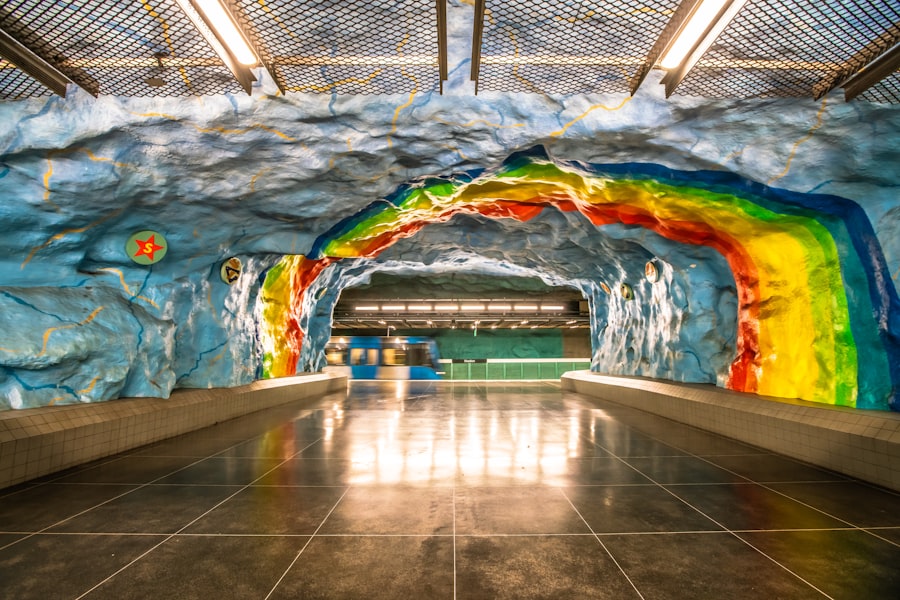
2. Stadion - The Rainbow Station
Stadion is arguably the most photogenic station in the entire system. The ceiling is a massive rainbow arching over the platform, painted by artist Enno Hallek and Olle Ahlberg in 1973. The colors are incredibly vibrant — red, orange, yellow, green, blue, and purple sweep across the rough bedrock. This is one of those Stockholm metro art photography spots where the sheer scale of the art takes your breath away.
Capturing the Vibe at Sunset
Visit Stadion around golden hour, but not for the sunlight. The magic happens when the artificial lights inside the station begin to warm up. The rainbow seems to glow from within. Position yourself at the base of the escalator on the lower platform. From here, you can shoot upward through the escalator glass, framing the rainbow behind the silhouettes of descending passengers. The contrast between the cool blue of the glass and the warm rainbow is stunning.
Composition and Framing
For composition, use the rule of thirds but with a twist. Place the arc of the rainbow in the upper third of your frame, letting the platform and tracks fill the bottom two thirds. This gives a sense of scale and place. Alternatively, lie on your back on the platform (carefully, and only when trains are not approaching) and shoot straight up. The rainbow will appear to explode outward from the center. This is a fantastic way to emphasize the immersive nature of the art.
Pro Photography Tips: Stadion is busy during rush hour, but that can work in your favor. Use a slow shutter speed (1/4 second) to blur the moving crowds while keeping the rainbow sharp. This creates a sense of energy and motion. For sharpness, rest your camera on a small beanbag or your camera bag on the platform floor.
3. Solna Centrum - The Fiery Red Cave
Solna Centrum is a political statement turned into art. The entire cave is painted in a deep, fiery red, with a massive green pine forest stretching along the walls. Artists Karl-Olov Bjork and Anders Aberg created this in 1975 to comment on deforestation and urbanization. The red is so intense it feels like you are standing inside a volcano. For Stockholm metro art photography spots with emotional weight, Solna Centrum is impossible to beat.
Lighting and Exposure Challenges
The red paint absorbs a lot of light, so you will need to adjust your exposure compensation by at least +1 stop. Otherwise, your camera will try to average the scene to gray, and the red will look muddy. Meter off the green forest section of the wall to get a balanced reading. The contrast between the red ceiling and the green band at eye level is the key to a successful image here.
Walking Directions and Angles
Take the Blue Line to Solna Centrum. Once you exit the train, walk to the far end of the platform where the tunnel curves. From this position, you can see the red walls converging into a point in the distance. Use a 35mm or 50mm lens to compress the perspective and make the tunnel feel even more dramatic. Wait for a person in a neutral-colored coat to walk through the scene to add a focal point and a sense of scale.
4. Kungstradgarden - The Archaeological Garden
Kungstradgarden is the deepest station in the system, and it feels like descending into an underground palace. The walls are decorated with sculptures, mosaics, and fragments from the old Royal Garden that once stood above ground. There are fountains, statues, and even a massive skeleton of a whale jawbone. The lighting here is theatrical — spotlights highlight specific artifacts while leaving the rest of the cave in deep shadow. This is one of the most atmospheric Stockholm metro art photography spots in the entire city.
Best Camera Settings for Low Light
You will need a fast lens for Kungstradgarden. An f/1.8 or f/1.4 prime lens is ideal. Set your aperture wide open to let in maximum light, and push your ISO to 1600 or 3200. The camera sensor noise will add a film-like grain that actually enhances the moody vibe. Use a spot metering mode to expose for the highlights on the sculptures, letting the shadows fall to black for a dramatic, chiaroscuro effect.
Framing the Artifacts
Do not try to capture everything at once. Instead, focus on individual pieces. The fountain with the mosaic tiles is a great subject. Get low to the ground and shoot upward to include the ceiling lights reflecting in the water. The whale jawbone is another must-capture. Frame it against the rough rock wall behind it, using a shallow depth of field to separate the bone from the stone.
5. Rissne - The World History Timeline
Rissne station features a massive mural that spans the entire length of the platform, depicting the history of the world from the Big Bang to modern times. The colors are earthy and muted, with ochre, terracotta, and deep browns dominating. For photographers who love storytelling, this is one of the most rewarding Stockholm metro art photography spots. The art unfolds like a comic strip, and you can spend hours walking the length of the platform, discovering new details.
Use a telephoto lens (70-200mm) to isolate specific sections of the mural. The faces and figures are rendered in a stylized, almost primitive way, and close-up shots reveal incredible brushwork. The lighting is even and diffuse, so you can shoot at f/5.6 for good sharpness across the mural section. Walk from the south end to the north end, and shoot every 10 meters to create a panorama sequence you can stitch together later.
6. Tensta - The Concrete Canvas
Tensta station is a celebration of community and diversity. The walls are covered in colorful abstract patterns, flowers, and human figures painted directly onto the rough concrete. The colors are bright and cheerful — pink, yellow, orange, and turquoise dominate. This is one of the most uplifting Stockholm metro art photography spots, and it is perfect for portrait photography. The colorful walls make a fantastic background for street-style portraits of your travel companions.
For lighting, the station has large windows at the entrance that let in natural light during the day. Visit in the morning when the light is soft and directional. Position your subject against a section of the wall with a strong color contrast — for example, a person in a blue coat against a pink wall. Use a wide aperture to blur the background slightly, keeping the focus on the subject while the colors remain a vibrant wash in the background.
7. Vastra Skogen - The Industrial Elegance
Vastra Skogen is a study in contrasts. The platform is split into two levels, with the upper level featuring a grid of white tiles that creates a futuristic, almost sci-fi atmosphere. The lower level is raw bedrock, left mostly untouched. The interplay between the man-made grid and the natural rock is a photographer's dream. For Stockholm metro art photography spots that explore texture and pattern, Vastra Skogen delivers in spades.
Shoot the white tile ceiling from below, using a super wide-angle lens. The grid will distort into a dramatic vanishing point. Then, pivot to the rock wall and shoot the texture with side lighting. The contrast between the smooth tiles and the rough stone is the story here. Use a tripod and take two exposures — one for the highlights on the tiles and one for the shadows on the rock — then blend them in post-processing.
8. Thorildsplan - The Pixel Art Paradise
Thorildsplan is a homage to classic video games. The station is decorated with pixelated mosaics of clouds, pipes, and stars that look like they are straight out of a Super Mario game. The colors are bright and blocky, and the vibe is playful and nostalgic. This is one of the most Instagram-friendly Stockholm metro art photography spots, but do not let that fool you into thinking it is easy to capture well.
The key to great photos at Thorildsplan is symmetry. The pixel art is arranged in repeating patterns along the walls. Stand directly in the center of the platform and shoot straight down the tunnel. The repeating columns of pixel clouds will create a hypnotic, rhythmic composition. Use a 24mm lens and keep the camera level. Correct any perspective distortion in post-processing to keep the grid lines perfectly straight.
9. Universitetet - The Scientific Wonder
Universitetet station serves Stockholm University, and the art reflects the academic setting. The walls are covered in geometric patterns, scientific formulas, and abstract representations of molecular
💬 Comments (0)
No comments yet. Be the first!