
Paris Brutalist Architecture: Top 10 Photo Spots
Discover the 10 most photogenic brutalist buildings in Paris. A 2026 guide to raw concrete aesthetics for striking urban photography.

Paris Brutalist Architecture: Top 10 Photo Spots
When you think of Paris, your mind likely wanders to Gothic cathedrals and Belle Epoque cafes, but let me introduce you to the city's striking, concrete-clad heartbeat: Paris Brutalist Architecture. In 2026, this architectural style is having a major moment, offering photographers like us a chance to capture the city's raw, geometric soul. This guide isn't just a list; it's your visual roadmap to the top ten locations where light, shadow, and form create unforgettable images. We'll dive deep into the history, the perfect camera settings, and even the exact walking routes to ensure you come away with stunning shots. So, charge your batteries and let's explore the bold, beautiful world of concrete in the City of Light.
Why Paris Brutalist Architecture Deserves Your Lens
Parisian Brutalism is a narrative of post-war innovation, a bold statement etched in concrete. These structures, often misunderstood, possess a monumental beauty. Their massive scales, repetitive patterns, and play with raw materials create a vibe that is both powerful and melancholic. For photographers, this means endless opportunities to experiment with dramatic lighting, compelling angles, and minimalist composition. Capturing Paris Brutalist Architecture is about more than documenting buildings; it's about framing the enduring spirit of a modern era.
1. Tour Montparnasse: The Concrete Giant
Rising 210 meters above the Parisian skyline, the Tour Montparnasse is arguably the most famous (and controversial) example of Paris Brutalist Architecture. Completed in 1973, this black-clad office tower was born from a period of rapid modernization. Its sheer, monolithic facade offers a stark contrast to the historic city below, creating a photographer's paradise for urban juxtaposition.
History and Photogenic Vibe
The tower's construction spurred such public outcry that it led to bans on new skyscrapers in the city center. Today, its vibe is one of imposing dominance. The best photographic perspectives come from the surrounding streets, where you can frame its towering presence against smaller, classic buildings.
Pro Photography Tips and Getting There
For the iconic shot, position yourself at the intersection of Rue de Rennes and Boulevard du Montparnasse. The converging lines of the streets lead the eye directly to the tower. Visit during the "golden hour" just before sunset; the warm light washes over the dark facade, creating a breathtaking glow. A wide-angle lens (16-35mm) is essential here to capture the full scale.
Pro Photography Tip: "For interior shots from the observation deck, use a polarizing filter to reduce glare on the windows. Compose your shot to include both the intricate concrete grid of the tower's facade and the sprawling cityscape beyond for a powerful sense of place."
Walking Directions from Gare Montparnasse: Exit the station onto Place Raoul Dautry. Walk north on Rue du Depart for approximately 200 meters. The tower will be directly in front of you. The entire walk takes about 3 minutes.
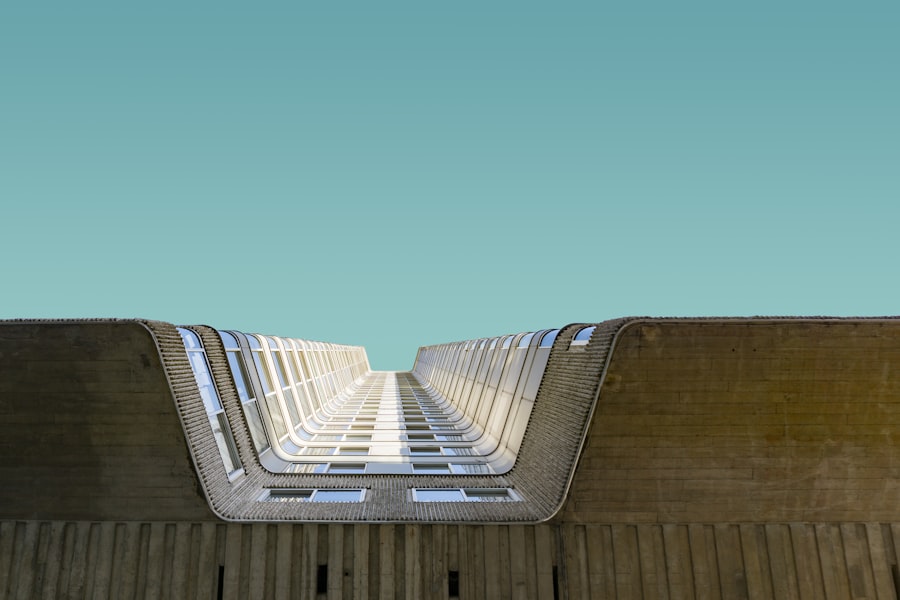
2. Les Espaces d'Abraxas: The Brutalist Palace
Venture to the eastern suburb of Noisy-le-Grand, and you'll find yourself in a surreal, cinematic landscape. Les Espaces d'Abraxas, designed by Spanish architect Ricardo Bofill and completed in 1983, is a monumental housing complex that feels like a dystopian fortress or a grand classical ruin rebuilt in concrete.
A Stage Set in Concrete
This location is a masterpiece of theatrical Brutalism. Comprising the Theatre, the Arc, and the Palacio, the complex features colossal columns, giant arches, and repetitive balconies. The vibe is overwhelmingly atmospheric, offering a hundred different frames in a single glance. It's a prime spot for exploring Paris Brutalist Architecture beyond the city center.
Key Angles to Capture:
- The central courtyard of the Theatre for symmetrical, imposing shots.
- Under the vast arches of the Arc to play with light and shadow.
- Detailed close-ups of the textured concrete and geometric patterns.
Camera Settings: Due to the high contrast between shadowed arches and bright sky, bracket your exposures. Start with an aperture of f/8 to f/11 for sharpness throughout the scene. A mid-range zoom lens (24-70mm) offers versatility.
Walking Directions from Noisy-le-Grand station (RER A): Exit the station and turn left onto Avenue de la Republique. Continue straight for about 10 minutes until you see the monumental structures on your left. You can't miss them.
3. Institut du Monde Arabe: Where Light Dances
On the Left Bank, the Institut du Monde Arabe (1987) by Jean Nouvel is a sophisticated take on Brutalism, blending concrete with steel and glass. Its south facade is legendary: featuring 240 motorized "Moucharabieh" diaphragms that open and close like camera lenses to control light.
Capturing the Mechanized Facade
The vibe here is one of intricate, technological poetry. The best time to photograph is on a sunny day when the diaphragms cast ever-changing geometric shadows across the interior. For exterior shots, late afternoon light highlights the texture of the concrete and the metallic details.
Pro Photography Tip: "Inside, head to the upper floors. Use a telephoto lens (70-200mm) to isolate patterns of the diaphragms against the Parisian skyline. For composition, look for frames within frames—shoot through the diaphragms to capture the Eiffel Tower or Notre-Dame in the distance."
Walking Directions from Notre-Dame: Cross the Pont de l'Archeveche to the Left Bank. Turn right onto Quai de la Tournelle and follow it for about 15 minutes. The institute will be on your left at 1 Rue des Fosses Saint-Bernard.
4. Bibliotheque nationale de France (BnF): The Four Open Books
Dominating the Seine in the 13th arrondissement, the BnF site Francois-Mitterrand (1996) is a cathedral of knowledge and a monumental example of late 20th-century Paris Brutalist Architecture. The four L-shaped glass towers, designed to resemble open books, are surrounded by vast wooden plazas and a sunken forest garden.
Composing Monumental Symmetry
The sheer scale here demands a careful approach to composition. The vibe is serene and intellectual. Early morning is magical, as mist often rises from the river, softening the concrete edges. Use the long reflecting pools to capture perfect symmetrical reflections of the towers.
Recommended Gear and Settings:
- Ultra-wide-angle lens (14-24mm) to capture the full plaza and tower bases.
- Sturdy tripod for long exposures at dawn or dusk.
- Set a low ISO (100) and a narrow aperture (f/16) for maximum depth of field.
Walking Directions from Gare d'Austerlitz: Exit the station towards the Seine. Walk south along the river on Quai de la Gare for approximately 8 minutes. You will see the four towers ahead. Cross the pedestrian bridge, Pass

Oliver Janssen scouts the best photography spots in every destination, from sunrise viewpoints to overlooked angles on famous landmarks. He shares exactly where to stand and when to be there for the shot.
💬 Comments (0)
No comments yet. Be the first!