Baku Architecture Photo Spots Guide
Explore the futuristic curves and flame towers with our guide to the top Baku architecture photo spots for creators.
Baku Architecture Photo Spots Guide: Capturing Azerbaijan's Futuristic Skyline and Historic Beauty
Baku architecture photo spots offer an incredible journey through time, seamlessly blending ancient Silk Road heritage with modern structural design. As a visual traveler, walking through the streets of Azerbaijan's capital feels like stepping between two distinct eras. The city boasts a dramatic cityscape where nineteenth-century European facades sit right next to towering hyper-modern masterpieces. In this comprehensive guide, we will explore the most photogenic corners of this city, giving you exact details on modern compositions, historic framing, lighting conditions, and camera settings to help you capture unforgettable images.
Whether you love Soviet classicism, futuristic steel curves, or ancient Islamic stonework, Baku delivers endless inspiration for your camera lens. Grab your wide-angle lens, pack a sturdy tripod, and let us dive into the ultimate visual journey across this Caspian seaside metropolis.
Futuristic Wonders: Modern Masterpieces in Baku
The contemporary Baku architecture photo spots are world-famous for pushing the limits of structural engineering and visual art. Over the past two decades, top international architects have transformed the city skyline into a playground of glass, steel, and light.
1. Heydar Aliyev Center
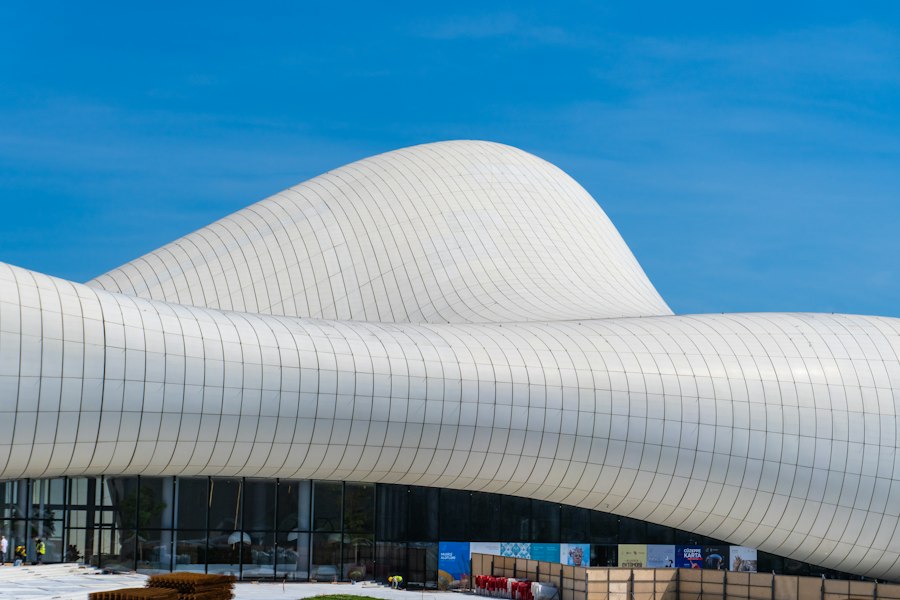
Designed by the legendary architect Zaha Hadid, the Heydar Aliyev Center is arguably the ultimate crown jewel among all Baku architecture photo spots. The building is famous for its flowing, curved design that completely avoids sharp angles. The white fluid structures rise gracefully from the surrounding concrete plaza, creating a seamless connection between the ground and the building itself.
To capture the best shots, arrive during the golden hour just before sunset. The soft amber light washes over the bright white skin of the building, creating gentle shadows that emphasize its signature organic curves. For an impactful composition, place a human subject at the base of the massive sweeping arches to give a true sense of scale. A low camera angle combined with a 16-35mm wide-angle lens allows you to frame the towering swoops against the sky.
- Best Lighting: Late afternoon golden hour and blue hour when the exterior ground lights illuminate the facade.
- Key Angles: The front zigzag steps, the side reflection pool, and the curved rear elevation.
- Vibe: Futuristic, ultra-clean, minimalist, and dreamlike.
Pro Photography Tips: Set your camera aperture to f/8 or f/11 for edge-to-edge sharpness across the massive structure. During blue hour, use a tripod and set a long exposure of 5 to 10 seconds at ISO 100 to smooth out any moving visitors and capture the glowing architectural lights with ultimate clarity.
2. The Flame Towers
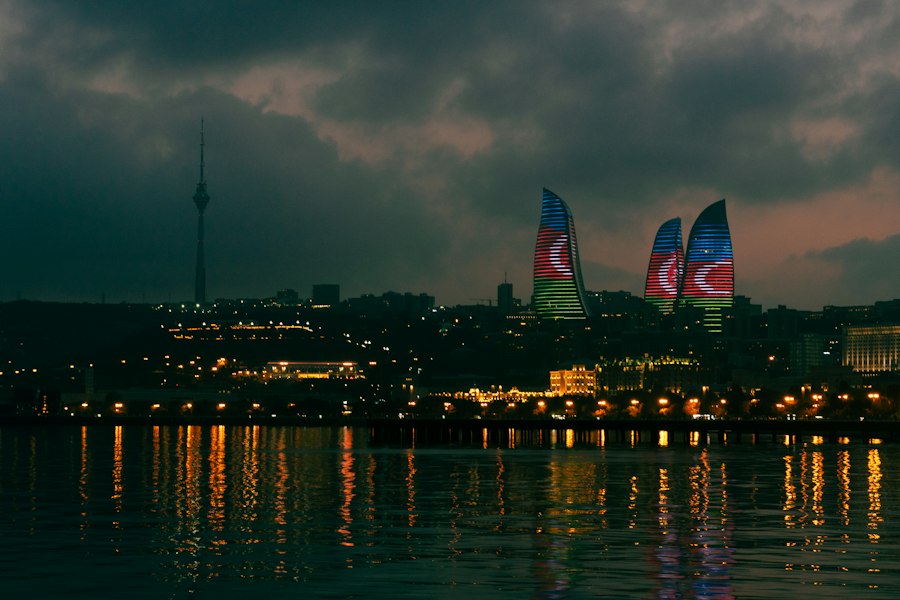
Rising high above the Baku Bay, these three curved glass skyscrapers resemble flickering tongues of fire, paying homage to Azerbaijan's history as the land of fire. The towers dominate the city horizon, making them a brilliant subject for distant cityscape framing as well as close-up architectural abstracts.
The best perspective for photographing the Flame Towers up close is from the base near Highland Park. Frame the towering structures looking straight up to highlight their dramatic height. Alternatively, shoot from across the bay along the Caspian Waterfront Promenade to catch their reflections in the dark sea water.
Historic Charm: Exploring the Walled City of Icherisheher
Stepping into Icherisheher, the UNESCO-listed Old Town, takes you away from the modern skyline and into a maze of limestone alleys, historic mosques, and ancient palaces. The contrast between these centuries-old structures and the modern towers in the background makes for breathtaking photo compositions.
3. The Maiden Tower (Qiz Qalasi)
This ancient cylindrical stone structure is wrapped in mystery, with historical origins dating back over a thousand years. The texture of the rough stone blocks provides a tactile element for architectural photography, especially when illuminated by side lighting in the early morning.
Walk down the surrounding narrow stone streets to find dramatic leading lines that guide the eye directly toward the tower. You can use historic wooden balconies or overhanging vines as natural framing elements. For travelers researching historic travel spots on Lonely Planet, this area consistently ranks as a must-see visual location.
- Recommended Focal Length: 24mm to 50mm for natural street perspective without excessive corner distortion.
- Composition Strategy: Use the tight stone alleys to frame the tower rising in the center frame.
- Vibe: Historic, moody, textures of stone, and ancient mystery.
4. Palace of the Shirvanshahs
This fifteenth-century palace complex showcases the finest traditions of Azerbaijani stone carving and Islamic architecture. The complex features grand courtyards, arched gateways, quiet mausoleums, and intricately carved doorways.
Focus on the details here. Look for geometric shadows cast by archways onto the pale sandstone floors during midday. Frame shots through ornate stone windows to capture contrast between bright courtyards and dark interior chambers. The subtle color variations in the aged stone look particularly striking under soft, diffused morning light.
European Splendor and Russian Imperial Eras
During the oil boom of the late nineteenth century, Baku expanded rapidly beyond its ancient walls. European architects were brought in to design grand residential mansions, public buildings, and theaters, resulting in an elegant Parisian feel across the central district.
5. Nizami Street and Fountains Square
Nizami Street is a bustling pedestrian thoroughfare lined with stunning Baroque, Neo-Gothic, and Renaissance Revival buildings. The detailed facades are decorated with ornate stone balconies, classical statues, and grand archways.
Bring a fast prime lens, such as a 50mm or 85mm f/1.8, to compress the street scene and isolate architectural details against soft background bokeh. At night, hanging street lamps light up the pedestrian zone, creating a classic European ambiance that is ideal for night street photography.
- Best Framing Technique: Position yourself in the center of the walkway and use the matching rows of vintage street lights as leading lines.
- Peak Time: Early morning for empty architectural shots; night for lively street atmosphere.
- Vibe: Elegant, opulent, classic European charm.
Pro Photography Tips: Look up! Many visual travelers forget to look at the upper levels of Nizami Street. Use a short telephoto zoom lens (like a 70-200mm) to isolate decorative stone faces, classical columns, and vintage ironwork balconies against the bright sky.
Waterfront Marvels and Modern Urban Spaces
The Caspian Sea coastline offers expansive open spaces where you can photograph modern installations against the backdrop of open sky and water. Taking advantage of water reflections adds an extra dimension to your gallery.
6. Baku Carpet Museum
Located right along the sea boulevard, the Baku Carpet Museum features one of the most unique structural designs in the world: the building itself is shaped like a giant rolled Azerbaijani carpet. Designed by Austrian architect Franz Janz, the curving metallic structure sits right along the green park pathways.
Capture the museum from a side angle to show off the rolling curve of the roof. The reflective silver skin of the building catches color from the sky, meaning sunset brings beautiful pink and orange tones across the metal tiles. When checking user reviews on TripAdvisor, visual travelers regularly highlight the surrounding gardens as ideal vantage points for capturing the full scale of the building.
Essential Gear and Shooting Tips for Baku
To make the absolute most of your time exploring Baku architecture photo spots, proper preparation is essential. The city experiences strong coastal winds from the Caspian Sea, which can introduce camera shake during long exposure photography, so bring a heavy, solid tripod.
A full range of lenses will serve you well. A wide-angle lens (14-24mm or 16-35mm) is vital for sweeping modern structures like the Heydar Aliyev Center and tight historic alleyways in Icherisheher. A medium zoom lens (24-70mm) covers general street scenes and classical facades, while a telephoto lens (70-200mm) helps isolate far-off decorative details on high-rise structures like the Flame Towers.
With its dramatic mix of historic stone walls, European grandeur, and world-class futuristic engineering, Baku offers endless creative opportunities for photographers. Pack your camera bag, keep your eye open for unique angles and light, and prepare to capture one of the most visually captivating cities in Eurasia.

Oliver Janssen scouts the best photography spots in every destination, from sunrise viewpoints to overlooked angles on famous landmarks. He shares exactly where to stand and when to be there for the shot.
💬 Comments (0)
No comments yet. Be the first!